
Patchwriting by Rick Perlstein (and Craig Shirley)
« previous post | next post »
Alexandra Alter, "Reagan Book Sets Off Debate", NYT 8/4/2014:
Mr. Perlstein’s new 856-page book, “The Invisible Bridge: The Fall of Nixon and the Rise of Reagan,” which comes out Tuesday, is proving to be almost as divisive as Reagan himself. It has drawn both strong reviews from prominent book critics, and sharp criticism from some scholars and commentators who accuse Mr. Perlstein of sloppy scholarship, improper attribution and plagiarism.
The most serious accusations come from a fellow Reagan historian, Craig Shirley, who said that Mr. Perlstein plagiarized several passages from Mr. Shirley’s 2004 book, “Reagan’s Revolution,” and used Mr. Shirley’s research numerous times without proper attribution.
In two letters to Mr. Perlstein’s publisher, Simon & Schuster, Mr. Shirley’s lawyer, Chris Ashby, cited 19 instances of duplicated language and inadequate attribution, and demanded $25 million in damages, a public apology, revised digital editions and the destruction of all physical copies of the book. Mr. Shirley said he has since tallied close to 50 instances where his work was used without credit.
The controversy has three different parts: Perlstein's use of online notes instead of notes within the published book; the ethical status of Perlstein's use of material from Shirley's book, with or without attribution; and the legal status of that usage. The most problematic of the accusations seem to be instances of what has been called "patchwriting", and that's the aspect of the controversy that I want to focus on.
My conclusion will be that Perlstein did indeed take idea-combinations and associated word-choices and word-sequences from Shirley; and he sometimes did this without specific attribution; but what he did seems to be within the normal boundaries of research methods for narrative histories, as indicated by the fact that Shirley did quite similar things with his own sources.
[The first few commenters have unfortunately chosen to fuss about the fact that Perlstein put his source notes online instead of at the end of the book. In my opinion, that's the least interesting part of the controversy. But the commenters' focus is probably explained by the fact that I made a remark on this topic at the start of this post; so I've moved the remark to the end, in the hopes of encouraging some readers to make it as far the the post's real point.]
Rick Perlstein's book is The Invisible Bridge: The Fall of Nixon and the Rise of Reagan,and Craig Shirley's book is Reagan's Revolution: The Untold Story of the Campaign That Started It All, 2005.
Here are the "Specific Examples of Infringement" given in a 7/25/2014 letter from Shirley's lawyers to Simon & Schuster:

Let's take up the first "Specific Example of Infringement", referencing p. 771 of Perlstein's book as copying from p. 297 of Shirley's book. This is the example that's been most widely discussed. What we'll find is
- Perlstein almost certainly took material from Shirley in writing the cited sentence
- Perlstein's Source Notes, though they do reference Shirley's book 125 times, do not cite this instance
- The relationship is an example of what has been called "patchwriting", which has been defined as "restating a phrase, clause, or one or more sentences while staying close to the language or syntax of the source"
- Patchwriting is common in this sort of narrative history — Shirley himself seems to have indulged in the same practice — see here for evidence
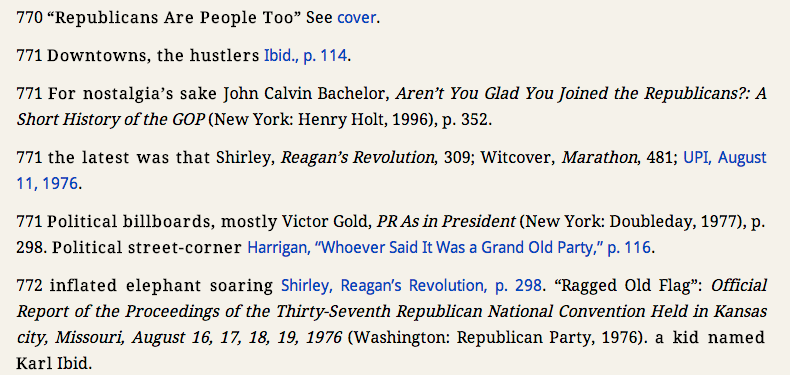
Here's the relevant segment of Perlstein's online "Source Notes" — the numbers refer to pages of his book:
Here's the stretch of Perlstein's book spanning these notes, with the noted items highlighted in yellow, and the alleged infringing passage highlighted in red:


As you can see, the allegedly infringing passage is not sourced – and it falls between an item sourced to Texas Monthly ("Downtown, the hustlers") and an item sourced to John Calvin Bachelor's book Aren't you glad you joined the Republicans? ("For nostalgia's sake").
Here's the relevant passage from Shirley's 2005 book, with the critical sentence highlighted in red:

(Note that Perlstein did cite the next paragraph of Shirley's book as the source of the "inflated elephant" anecdote, suggesting that he was not trying to hide anything.
Anyhow, here's another side-by-side comparison of the claimed-to-be-infringing sentences:
| Shirley | Perlstein |
| Even its "red light" district was festooned with red, white, and blue bunting, as dancing elephants were placed the windows of several smut peddlers. | The city's anemic red-light district was festooned with red, white, and blue bunting; several of the smut peddlers featured dancers in elephant costume in their windows. |
This seems to be the most serious of the complaints that I've seen so far, since it involves an identical 11-word sequence, and the juxtaposition in the same sentence with the phrase "smut peddlars" and the idea of dancing elephants in their windows. Shirley's other complaints, at least the ones detailed in the cited lawyer's letter, seem less serious — they involve brief paraphrases, possible borrowing of evocative details, or re-expressions of similar content that might have been drawn from any number of sources.
For completeness, we should check whether the shared language in this sentence might have come in whole or in part from one of the sources that pre-date both books, such as the 1976 Texas Monthly story or Bachelor's 1996 book. But on the basis of the evidence available so far, it looks like Perlstein is guilty in this case of patchwriting without attribution.
As discussed at length in an earlier LLOG post ("Patchwriting", 6/13/2014), there's considerable disagreement about whether patchwriting is culpable plagiarism from a policy point of view — some people call it "a very serious matter" while others assert that it "should be acceptable to writing teachers". It's obviously more serious when it's done without attribution.
But this sort of thing seems to be very difficult to avoid in narrative history, and there's no bright line, in my opinion, between more and less culpable examples.
For an example of how easy it is to create apparently-well-founded accusations of this sort of thing, consider this passage, about that same 1976 convention, from Shirley's book:
Tempers were running high. A confrontation involving Nelson Rockefeller took place on the floor before the vote, when a Utah delegate ripped out the white phone that connected the New York delegation to the Ford command post after he saw Rocky had taken a Reagan placard from a delegate in the North Carolina contingent. Perspiring heavily through his shirt, the Vice President held up the phone and attached cord for all to see, but many saw the image as a metaphor of his inability to communicate with his own party.
Now compare it with this New York Times story, which contains a similar passage:
… Vice President Rockefeller stole a Reagan-for-President sign from a North Carolina delegate … In angry retaliation, a delegate from Utah stormed across the aisle to the New York seats … and ripped out the white telephone that links the delegation to the Ford control trailer. [...] Then the crowd parted and Mr. Rockefeller … posed for the cameras holding the white telephone and its dismembered white cord high in the air. [...] "He held it up. He wanted me to take it," said a laughing Mr. Rockefeller, perspiration soaking his blue-and-white striped shirt.
Did Shirley borrow the details and paraphrase the language from this NYT story (which he does not footnote, though he references an R.W. Apple story in the same edition)? It seems likely that he did – there are some fragments that actually count as patchwriting, in my opinion:
| Shirley | NYT |
| a Utah delegate ripped out the white phone that connected the New York delegation to the Ford command post | a delegate from Utah stormed across the aisle to the New York seats … and ripped out the white telephone that links the delegation to the Ford control trailer |
| Perspiring heavily through his shirt, the Vice President held up the phone and attached cord for all to see | Mr Rockefeller … posed for the cameras holding up the white telephone and its dismembered white cord high in the air … perspiration soaking his blue-and-white striped shirt. |
Should the New York Times threaten to sue Mr. Shirley for plagiarism? I don't think so — this seems to me like a commonplace use of published sources, though he should have footnoted the NYT story, or given some other source for the event's details.
(I should note that this is the first and only passage in Shirley's book that I checked — I picked it because it has some vivid details, like Rockefeller sweating through his shirt while holding up the white phone with its dangling cord, which I expected to be able to find mentioned in contemporary news stories. Given that the first test turns up a source that has apparently been the basis for patchwriting without attribution, it seems likely that that are more than a few other cases elsewhere in Shirley's book.)
So in the end, my judgment is that Mr. Perlstein's sins are generally similar to those of Mr. Shirley, who ought perhaps to re-read John 8:1-11.
Some other relevant links, among many:
Criag Shirley, "A statement in response to the stories that have appeared regarding my 2005 work Reagan’s Revolution and the soon-to-be-released book The Invisible Bridge", 8/3/2014
David Weigel, "The Simplifier", Slate 8/5/2014
David Weigel, "Read the Letters at the Center of the New Reagan Book 'Plagiarism' Controversy", Slate 8/5/2014
Paul Krugman, "Sliming Rick Perlstein", NYT 8/5/2014
David Dayen, "The right’s 'plagiarism' scam: How low it will stoop to protect Reagan’s legacy", Salon 8/6/2014
Tim Cavanaugh, "Rick Perlstein: Probable Plagiarist, Definite Jerk", National Review Online 8/6/2014
Jeffrey Lord, "Is Rick Perlstein the new Doris Kearns Goodwin?", The American Spectator 8/7/2014
Henry Farrell, "Reagan and plagiarism", Crooked Timber 8/7/2014
David Weigel, "The Simplifier", Slate 8/5/2014
David Weigel, "Read the Letters at the Center of the New Reagan Book 'Plagiarism' Controversy", Slate 8/5/2014
Paul Krugman, "Sliming Rick Perlstein", NYT 8/5/2014
David Dayen, "The right’s 'plagiarism' scam: How low it will stoop to protect Reagan’s legacy", Salon 8/6/2014
Tim Cavanaugh, "Rick Perlstein: Probable Plagiarist, Definite Jerk", National Review Online 8/6/2014
Jeffrey Lord, "Is Rick Perlstein the new Doris Kearns Goodwin?", The American Spectator 8/7/2014
Henry Farrell, "Reagan and plagiarism", Crooked Timber 8/7/2014
There have been complaints that Perlstein relies on online "Source Notes" rather than putting endnotes in the book itself. From Alter's NYT article again:
The debate about Mr. Perlstein’s book also calls into question the growing practice of shifting endnotes out of print books and onto the web. In what Mr. Perlstein calls “a publishing innovation,” readers of “The Invisible Bridge” are directed to a trove of digital citations on Mr. Perlstein’s website.
He and his publisher said they moved the endnotes online not just to save money — the notes would have made the hardcover edition unwieldy and expensive at 1,000-plus pages — but also to make his research more transparent by providing links to the books, newspaper clippings and news reports that Mr. Perlstein drew on. “I want to expand this idea of history as a collective enterprise,” he said. “My notion is that people will read this book with their iPhones open.”
But many academics and publishers remain uncomfortable with the practice, saying it requires readers to take an extra step to find a writer’s sources, and that online documentation could be easily lost. “The concern for me is that the URLs won’t live forever, and future scholars could be frustrated if they cannot easily find the notes,” said Bruce Nichols, the publisher of Houghton Mifflin Harcourt.
It would be fair to complain that the Source Notes exist only on Rick Perlstein's personal web site, and that the link to those notes is deeply buried in the book — in fact the very last sentence — and that the link leads only to Perlstein's home page, which is two steps removed from the Source Notes.
But with all due respect, Mr. Nichols' complaint, as reported in above, is deeply silly. He might plausibly argue that Perlstein's Source Notes should have been deposited with the Internet Archive, or with WikiSource, or with a library that undertakes to keep them available indefinitely, or all of the above, and that a link should have been prominently featured at the start of the book. Even more plausibly, he might argue that Perstein and/or his publisher should use something like the DOI system to ensure that future scholars can find the official version of the Source Notes, or perhaps a series of authoritatively time-stamped editions of them.
But if you want to know why the publishing industry is in trouble, just ponder the fact that the leader of a major publishing house responded to this issue by noting that "URLs won't live forever". This is like an executive of the 19th-century horse-harness industry complaining that automobiles cause air pollution.


No comments:
Post a Comment