
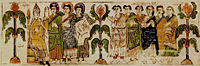
The people of Toledo.
The Codex Vigilanus (Albeldensis) or Códice Albeldense (Vigilano), full nameCodex Conciliorum Albeldensis seu Vigilanus, is an illuminated compilation ofvarious historical documents accounting for a period extending from antiquity tothe 10th century in Hispania. Among the many texts brought together by thecompilers are the canons of the Councils of Toledo, the Liber Iudiciorum, thedecrees of some early popes and other patristic writings, historical narratives(such as the Crónica Albeldense[1] and a life of Mohammed), various otherpieces of civil and canon law, and a calendar.
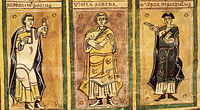
The scribes: Serracino, Vigila, andGarcía as drawn by Vigila.
The compilers were three monks of the Riojan monastery of San Martín deAlbelda: Vigila, after whom it was named and who was the illustrator; Serracino,his friend; and García, his disciple. The first compilation was finished in 881, butwas updated up to 976. The original manuscript is preserved in the library of El Escorial (as Escorialensis d I 2). At the time of its compilation, Albelda was thecultural and intellectual centre of the Kingdom of Pamplona. The manuscriptscelebrate with illustrations not only the ancient Gothic kings who had reformedthe law — Chindasuinth, Reccesuinth, and Ergica — but also its contemporarydedicatees, the rulers of Navarre: Sancho II of Pamplona and his queen,Urraca, and his brother Ramiro Garcés, King of Viguera.
The Codex contains, among other pieces of useful information, the first mention and representation of Arabic numerals(save zero) in the West. They were introduced by the Arabs into Spain around 900.
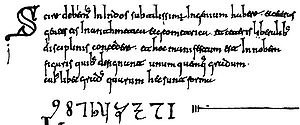
The first Arabic numerals in the West.
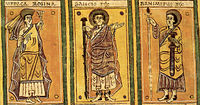
Sancho, centred, flanked by his queen,Urraca, left, and his brother, Ramiro,right.
From the Codex Vigilanus.
From the Codex Vigilanus.
The illuminations are stylisticallyunique, combining Visigothic,Mozarabic, and Carolingianelements. The interlace patterns andthe drapery show Carolingian, as wellItalo-Byzantine, influence.[2] The useof animals as decoration and forsupporting columns also parallelscontemporary Frankish usage.[3]More Carolingian and less Byzantineinfluence is evident in the CodexAemilianensis, a copy of the Vigilanusmade at San Millán de la Cogolla in992 by a different illustrator.[4]


No comments:
Post a Comment