
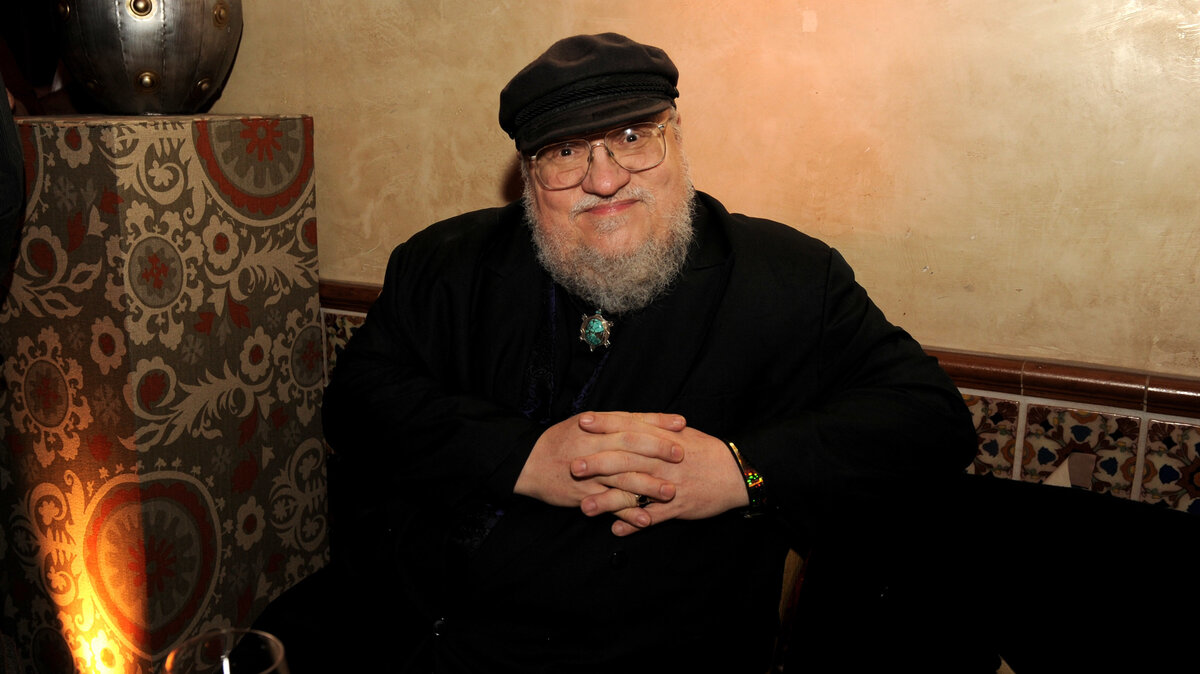
George R.R. Martin attends a 2013 afterparty for HBO's Game Of Thrones, which was adapted from his epic fantasy series, A Song of Ice and Fire. Kevin Winter/Getty Images hide caption
toggle caption
Kevin Winter/Getty Images
Because he doesn't like to be asked when the next volume will appear, Martin doesn't do a lot of interviews — but I got to speak with him last week onstage when he received the Chicago Public Library Foundation's Carl Sandburg Literary Award.
Martin told me the icy apocalypse that's central to A Song of Ice and Fire was inspired by his freshman year at Northwestern University. "I guess this was early in '67, and they had this incredible snowstorm, and the snow was so thick I got lost on this campus that I'd walk every day. You couldn't see the buildings, you couldn't see 5 feet in front of you, the snow was just coming down so heavily, and by the time the snowstorm stopped — I was on the first floor, the windows were completely covered. Then it froze and it didn't melt for days, weeks ... And we would go out of the dormitory, and we would be in a trench with walls above our head of snow and ice. It was like a transformed world. And I think that got its fingers into my memory somehow and may have had some influence when I started writing about the Wall in Westeros and the men of the Night's Watch."

On how he keeps track of his expanding character count
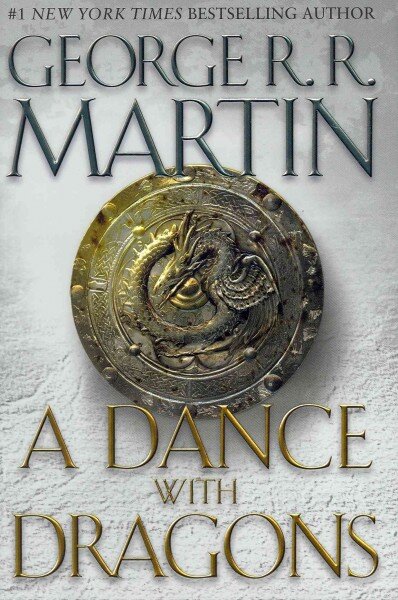
A Dance With Dragons
And then there are the gardeners, who dig a hole, and they plant a seed and they water it — in the case of writers, with their blood and their tears and their sweat — and they hope that something comes up. And they have a general idea — they know whether they planted an acorn or a tomato plant. But there's lots of surprises. Sometimes it doesn't come up at all, or it comes up and dies. And sometimes it gets very wild. And that's me, I'm much more a gardener than an architect. In that way, I'm like J.R.R. Tolkien and others — it's not the most efficient method of writing ... but it's worked for me all my life, so I'm probably going to keep continuing doing it that way.
On the violence in his books
Like Tolkien, many of the great fantasy stories, at heart, A Song of Ice and Fire is a war story. And I think if you're going to write about war, whether you're writing about a fictional war for the Iron Throne of Westeros or a struggle against Sauron to preserve the free peoples of Middle-earth. Or you're writing about World War II or you're writing about the American Civil War or you're writing about everything, you're not honest if you don't include sex and violence.
On whether it's difficult to have millions of people waiting for The Winds of Winter, the next volume of A Song of Ice and Fire
Yes, especially because a certain portion of them are really impatient and snarky about it. You know, you can get one person who posts 150 messages in three days, all of which is "Where is Winds of Winter?" If any of you go home and post on your Twitter account, "Hey I was just at the Chicago Public Library Sandburg Award dinner and George R.R. Martin was there," you know by the third message someone will say, well, "What the hell is he doing there? Where is Winds of Winter?" So at this point, it is what it is. And, you know, I should probably leave right now and go back [to] writing Winds of Winter.
It's very important me to finish A Song of Ice and Fire. I want to finish it. I still have two more books to do, and I want to finish it strong. So people look at it and say, you know, this entire thing is an important work, not a half-finished or broken work. I know some of the more cynical people out there don't believe that, but it is true.


No comments:
Post a Comment