
The Science of Nuclear Weapons, Visualized

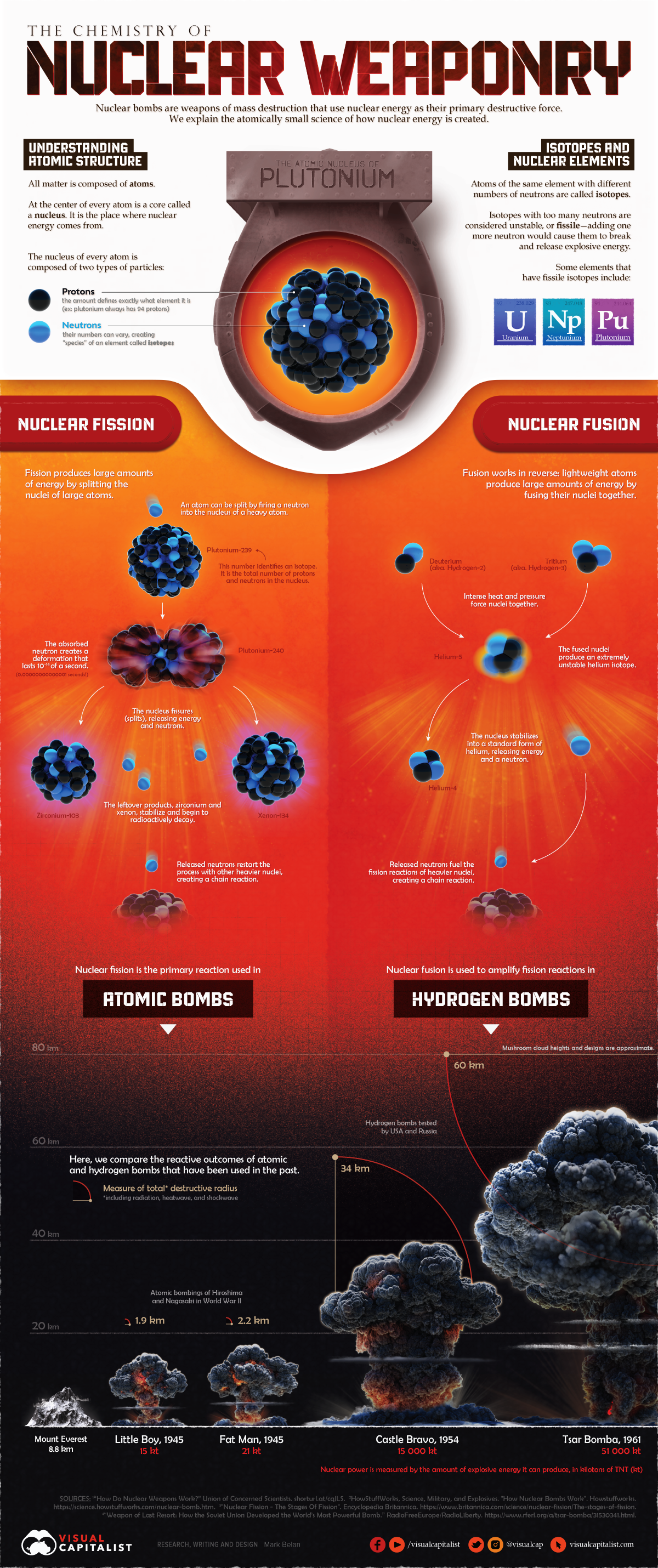
Visualized: How Nuclear Weapons Work
In 1945, the world’s first-ever nuclear weapon was detonated at the Trinity test site in New Mexico, United States, marking the beginning of the Atomic Age.
Since then, the global nuclear stockpile has multiplied, and when geopolitical tensions rise, the idea of a nuclear apocalypse understandably causes widespread concern.
But despite their catastrophically large effects, the science of how nuclear weapons work is atomically small.
The Atomic Science of Nuclear Weapons
All matter is composed of atoms, which host different combinations of three particles—protons, electrons, and neutrons. Nuclear weapons work by capitalizing on the interactions of protons and neutrons to create an explosive chain reaction.
At the center of every atom is a core called the nucleus, which is composed of closely-bound protons and neutrons. While the number of protons is unique to each element in the periodic table, the number of neutrons can vary. As a result, there are multiple “species” of some elements, known as isotopes.
For example, here are some isotopes of uranium:
- Uranium-238: 92 protons, 146 neutrons
- Uranium-235: 92 protons, 143 neutrons
- Uranium-234: 92 protons, 142 neutrons
These isotopes can be stable or unstable. Stable isotopes have a relatively static or unchanging number of neutrons. But when a chemical element has too many neutrons, it becomes unstable or fissile.
When fissile isotopes attempt to become stable, they shed excess neutrons and energy. This energy is where nuclear weapons get their explosivity from.
There are two types of nuclear weapons:
- Atomic Bombs: These rely on a domino effect of multiple fission reactions to produce an explosion, using either uranium or plutonium.
- Hydrogen Bombs: These rely on a combination of fission and fusion using uranium or plutonium, with the help of lighter elements like the isotopes of hydrogen.
So, what exactly is the difference between fission and fusion reactions?
Splitting Atoms: Nuclear Fission
Nuclear fission—the process used by nuclear reactors—produces large amounts of energy by breaking apart a heavier unstable atom into two smaller atoms, starting a nuclear chain reaction.
When a neutron is fired into the nucleus of a fissile atom like uranium-235, the uranium atom splits into two smaller atoms known as “fissile fragments” in addition to more neutrons and energy. These excess neutrons can then start a self-sustaining chain reaction by hitting the nuclei of other uranium-235 atoms, resulting in an atomic explosion.
Atomic bombs use nuclear fission, though it’s important to note that a fission chain reaction requires a particular amount of a fissile material like uranium-235, known as the supercritical mass.
Merging Atoms: Nuclear Fusion
Hydrogen bombs use a combination of fission and fusion, with nuclear fusion amplifying a fission reaction to produce a much more powerful explosion than atomic bombs.
Fusion is essentially the opposite of fission—instead of splitting a heavier atom into smaller atoms, it works by putting together two atoms to form a third unstable atom. It’s also the same process that fuels the Sun.
Nuclear fusion mainly relies on isotopes of lighter elements, like the two isotopes of hydrogen—deuterium and tritium. When subjected to intense heat and pressure, these two atoms fuse together to form an extremely unstable helium isotope, which releases energy and neutrons.
The released neutrons then fuel the fission reactions of heavier atoms like uranium-235, creating an explosive chain reaction.
How Atomic and Hydrogen Bombs Compare
Just how powerful are hydrogen bombs, and how do they compare to atomic bombs?
| Bomb | Type | Energy produced (kilotons of TNT) |
|---|---|---|
| Little Boy | Atomic | 15kt |
| Fat Man | Atomic | 21kt |
| Castle Bravo | Hydrogen | 15,000kt |
| Tsar Bomba | Hydrogen | 51,000kt |
The bombs Little Boy and Fat Man were used in the atomic bombings of Hiroshima and Nagasaki in 1945, bringing a destructive end to World War II. The scale of these bombings was, at the time, unparalleled. But comparing these to hydrogen bombs shows just how powerful nuclear weapons have become.
Castle Bravo was the codename for the United States’ largest-ever nuclear weapon test, a hydrogen bomb that produced a yield of 15,000 kilotons—making it 1,000 times more powerful than Little Boy. What’s more, radioactive traces from the explosion, which took place on the Marshall Islands near Fiji, were found in Australia, India, Japan, U.S., and Europe.
Seven years later, the Soviet Union tested Tsar Bomba in 1961, the world’s most powerful nuclear weapon. The explosion produced 51,000 kilotons of explosive energy, with a destructive radius of roughly 60km.
Given how damaging a single nuke can be, it’s difficult to imagine the outcome of an actual nuclear conflict without fear of total annihilation, especially with the world’s nuclear arsenal sitting at over 13,000 warheads.
Politics
Mapped: All the World’s Military Personnel
Which countries have the biggest militaries in the world? This map reveals all the world’s military personnel.
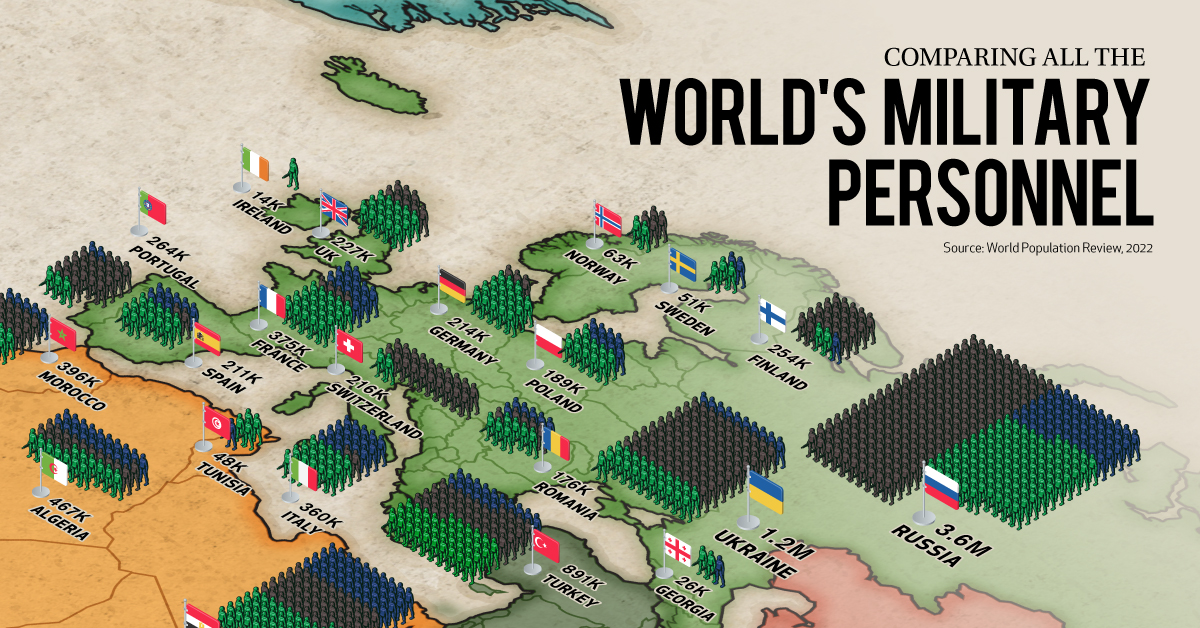
Mapped: All the World’s Military Personnel
While much of the world is living in one of the most peaceful periods in history, the spark of new conflicts like Russia’s invasion of Ukraine reminds us of the importance of military personnel.
Between ongoing armed conflicts to building of defenses preemptively, many countries have amassed significant militaries to date.
This map, using data from World Population Review, displays all the world’s military personnel.
Who Has the Largest Military?
So who has the largest military? Well, the answer isn’t so simple.
There are three commonly measured categories of military personnel:
- Active military: Soldiers who work full-time for the army
Country with the largest active military: China (over 2 million) - Military reserves: People who do not work for the army full-time, but have military training and can be called up and deployed at any moment
Country with the largest military reserves: Vietnam (5 million) - Paramilitary: Groups that aren’t officially military but operate in a similar fashion, such as the CIA or SWAT teams in the U.S.
Country with the largest paramilitary: North Korea (an estimated 5 million)
NOTE: Of these categories of military personnel, paramilitary is the least well-defined across the world’s countries and thus not included in the infographic above.
Which country has the biggest military? It depends who’s doing the counting.
If we include paramilitary forces, here’s how the top countries stack up in terms of military personnel:
Source: World Population Review
When combining all three types of military, Vietnam comes out on top with over 10 million personnel.
And here are the world’s top 10 biggest militaries, excluding paramilitary forces:
Even in this case, North Korea remains near the top of the list with these much larger nations. Excluding estimates of paramilitary forces, the Hermit Kingdom has nearly 1.9 million active and reserve troops.
Building up Military Personnel
The reasons for these immense military sizes are obvious in some cases. For example, in Vietnam, North Korea, and Russia, citizens are required to serve a mandatory period of time for the military.
The Koreas, two countries still technically at war, both conscript citizens for their armies. In North Korea, boys are conscripted at age 14. They begin active service at age 17 and remain in the army for another 13 years. In select cases, women are conscripted as well.
In South Korea, a man must enlist at some point between the ages of 18 and 28. Most service terms are just over one year at minimum. There are however, certain exceptions: the K-Pop group BTS was recently granted legal rights to delay their military service, thanks to the country’s culture minister.
Here’s a look at just a few of the other countries that require their citizens to serve some form of military service:
- Austria
- Brazil
- Myanmar
- Egypt
- Israel
- Ukraine
In many of these countries, geopolitical and historical factors play into why they have mandatory service in place.
In the U.S., many different factors play into why the country has such a large military force. For one, the military industrial complex feeds into the U.S. army. A longstanding tradition of the American government and the defense and weapons industry working closely together creates economic incentives to build up arms and defenses, translating into a need for more personnel.
Additionally, the U.S. army offers job security and safety nets, and can be an attractive career choice. Culturally, the military is also held in high esteem in the country.
Nations with No Armies
For many countries, building up military personnel is a priority, however, there are other nations who have no armies at all (excluding the paramilitary branch).
Here’s a glance at some countries that have no armies:
- Costa Rica
- Iceland
- Liechtenstein
- Panama
Costa Rica has no army as it was dissolved after the country’s civil war in the 1940s. The funds for the military were redirected towards other public services, such as education.
This is not to say that these nations live in a state of constant peace—most have found alternative means to garner security forces. Under the Inter-American Treaty of Reciprocal Assistance, other countries like the U.S. are technically obligated to provide military services to Costa Rica, for example, should they be in need.
The Future of Warfare
International conflicts persist in the 21st century, but now go far beyond just the number of troops on the ground.
New and emerging forms of warfare pose unforeseen threats. For example, cyber warfare and utilization of data to attack populations could dismantle countries and cause conflict almost instantaneously. Cybersecurity failure has been ranked among the top 10 most likely risks to the world today.
If current trends continue, soldiers of the future will face off on very different fields of battle.
Politics
A Visual Guide to Europe’s Member States
Europe’s member states are part of one or more of the four major treaty groups. Here we map the countries that are part of these groups.
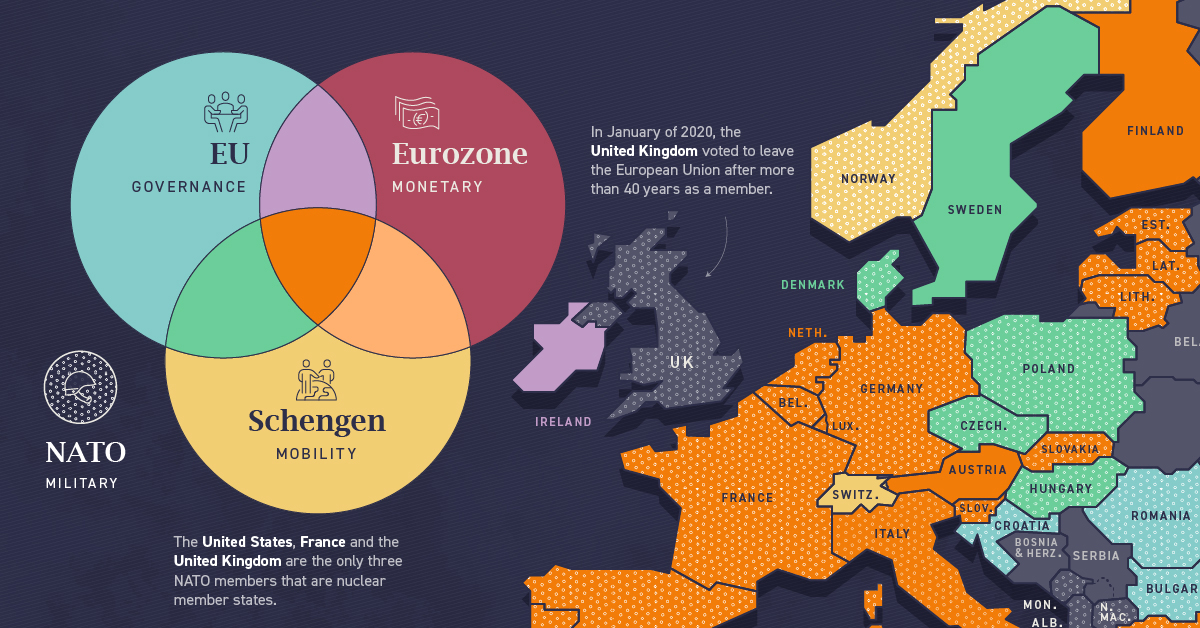
Who are Europe’s Member States?
With Ukraine’s recent bid to join the European Union (EU), the current status of Europe’s member states is back in the fray.
The European member states are countries mainly in Europe, and three outside, that are part of one or more of the four major treaty groups, namely the European Union (EU), NATO, Schengen, and eurozone.
Each of these institutions governs a different aspect of the region’s infrastructure.
Let’s take a look at each of them.
European Union
The European Union (EU) is a unique economic and political union between 27 European countries.
First created as the European Economic Community in the aftermath of WW2, the organization’s main focus was to foster economic cooperation. The idea was simple: countries that trade with one another and become economically interdependent are more likely to avoid conflict.
Beginning with six countries in 1958, the European Economic Community has since added 21 more countries (the UK left the EU in 2020), with a primary focus on single or internal markets.
Here are the countries that comprise the European Union:
What began as a purely economic union has evolved into an organization pioneering the development of many different policy areas. A name change from the European Economic Community to the European Union in 1993 reflected this.
NATO
The North Atlantic Treaty Organization (NATO) exists for the sole purpose of facilitating a political and military alliance between its 30 member countries.
Established in 1949 in response to post-WW2 Soviet aggression, NATO exists for the collective defense and security of the group. Members share few laws and regulations. An attack on one constitutes an attack on all, and member states are obligated to defend one another.
The chronological timeline of NATO’s expansion since its establishment paints a fascinating picture.
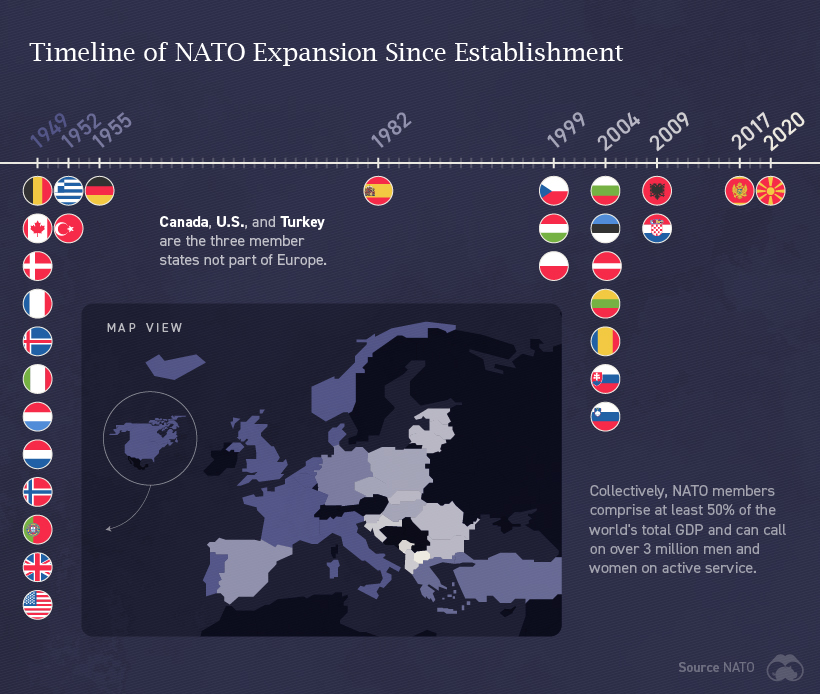
As of 2021, NATO officially recognizes three aspiring NATO members: Bosnia and Herzegovina, Georgia, and Ukraine. Ukraine has voiced its desire to join NATO since 2014 but hasn’t met its political and military criteria.
Eurozone
The eurozone is a geographic and economic region that consists of countries that have adopted the euro as their national currency. Approximately 340 million people live in the euro area.
Today, the eurozone consists of 19 countries of the European Union. Here they are:
European Union nations that decide to participate in the eurozone must meet a multitude of financial requirements. They include price stability, sound public finances, the durability of convergence, and exchange rate stability.
Not all countries have to adopt the currency, though. For example, Denmark has a special opt-out clause to use its own currency and maintain its financial independence.
Schengen
The Schengen Area comprises 26 European countries that agreed to create common entry and exit requirements to remove the need for internal borders. This allows travellers up to 90 days of visa-free travel to any of the countries in the Schengen Area.
The border-free Schengen Area guarantees free movement to more than 400 million EU citizens, along with non-EU nationals living in the EU or visiting as tourists, exchange students, or for business purposes.
Here’s a list of the 26 countries that are a part of the Schengen Area:
Monaco, Vatican City, and San Marino also have open borders with Schengen area countries even though they aren’t part of the treaty.


No comments:
Post a Comment